Monday, 22 December 2014

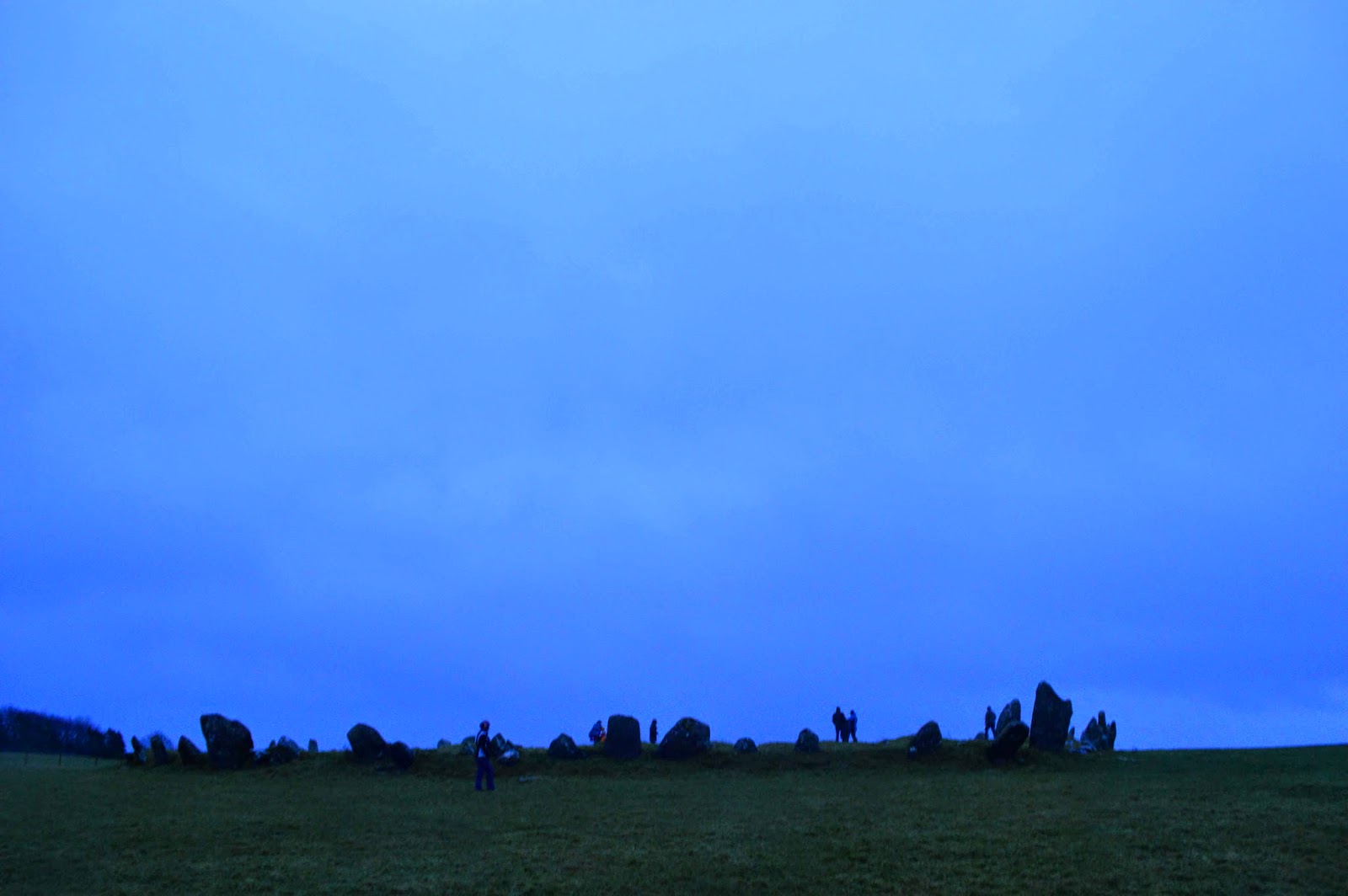
Winter solstice at Beltony with the High Kings


Out today to the stone circle at Beltony, a couple of miles from Raphoe. It is, of course, the winter solstice. We got there just after half eight. We arrived just behind a teller of tales and just ahead of Kathryn Daily and Stephen. Kathryn has put pics up on Facebook.

On the path up, we passed the remains of a circular structure among the trees on the right. As a child I'd always imagined this to be a round tower. I was disappointed to see it marked on a map as a windmill. But then lo and behold! in the Donegal Annual Volume 1 (1947-1953) there's a note about it being a round tower after all. Still looking for that note - I think it said the tower was used as a scriptorium, a place for copying manuscripts. The tower might also have been useful for keeping an eye on the stone circle and who might be going there.

This little hill is where I grew up, in a house beside where you park your car now before taking the short but steep-ish lane to the circle. This townland is called The Tops. It's a good description of it as a place to spend your early years, but again I was a little disappointed that the townland name wasn't an ancient Irish one linked with the circle. Then a while back I opened the Irish Times and found The Tops mentioned in the 'Words We Use' column from Diarmuid Ó Muirthile. It seems the name comes from 'Tap tineadh', the place where the torches were lit before the procession to the circle. Perfect! Coincidentally, I see that Diarmuid's death in Vienna was reported in the Irish Times exactly a year ago today.

There are many fascinating aspects to the circle and indeed the landscape around it. For instance, what monastery is linked with the round tower? An obvious candidate is the monastery at Raphoe - the town name comes from 'Rath Bhoth', the fortification around the (monk's) huts, as we were taught at school. It's thought these huts were made by monks. But I remembered today that not far from the stone circle there is a townland called Ballymonaster, the land of the monastery. I see that in the same area, known locally as Cloughfin, there's also Kilmonaster Lower, Kilmonaster Middle and Churchminister. Jim Lynch, who taught me at Raphoe NS, is a former principal of St Colmcille NS Cloughfin and writes that the Cistercians had a monastery there with Cearnach as abbot.


Christian settlements were often established close to pagan ones, I suppose for the same reasons that Christian festivals were established to supplant pagan ones. The winter solstice rituals gave way to Christmas. This concentration of Christian settlement around Beltony stone circle suggests it was an important place. We all search for significance in our lives. Patrick Kavanagh poked fun at our fond imaginings in his poem 'Epic' -

I have lived in important places, times
When great events were decided : who owned
That half a rood of rock, a no-man's land
Surrounded by our pitchfork-armed claims

However the Tops and Beltony just keep delivering the goods. In his book published in 2006, 'Cenél Conaill and the Donegal Kingdoms AD 500 - 800', Brian Lacey persuasively argues that this part of East Donegal was the homeland of a powerful clan, the Cenél Conaill. This clan began to make a 'national' impact from their "small but economically rich territory in Mag nItha" in the sixth century. According to this analysis, the clan supplied at least five high kings of Tara. Two, and possibly three, of these Cenél Conaill kings of Tara "were the first to be described in the ancient sources with the rare title of 'King of Ireland', however exaggerated that was" (p322).


There was no sun to be seen at sunrise this morning. But when you were looking across in vain towards Croaghan Hill you were surveying the home ground of the Cenél Conaill and your feet were  firmly planted in historic Irish landscape.


*******************

By coincidence last night I found myself at a 'Celtic Banquet' at the Grianan of Aileach Hotel in Burt. Brian Lacey reckons that the great hillfort Grianan of Aileach symbolises the transfer of power away from Cenél Conaill to the Cenél nÉogain after the battle of Clóiteach in 789. Brian suggests that Cenél nÉogain chief Áed may have celebrated his victory over Cenél Conaill by building the Grianan of Aileach - "as a visible reminder of who ruled, the monument could be seen from a great many parts of that kingdom". The Cenél nÉogain, who gave their name to Inishowen, then became big cheeses in Ireland. The Cenél Conaill was practically written out of the annals in what Brian likens to"a sort of Stalinization". History is written by the victors. But as recent resident of Fahan, that historic Inishowen spot, I also claim Cenél nÉogain connections!

********************

Friday, 12 December 2014

Eyewitness account of the fire at Raphoe Castle 1838


Came across a curious little book in the library in Letterkenny, 'Reminiscences of a Long Life', by W. D. Killen, D.D., LL.D., President of Belfast Presbyterian College. It's a little A6 size one (the pages a quarter of an A4 page) and it's number 145 of an edition of just 200 copies produced by Braid Books and Moyola Books in 1995.
The great treat for a Raphoe man in this book is the eyewitness description of the fire which destroyed Raphoe Castle in 1838. William Doole lived through almost all of the 19th century, and he was serving as Presbyterian Minister in Raphoe at the time of the fire. And there's much more of interest in the book, including more about life in Raphoe during his ministry there, a description of Belfast in 1820, when it was still a relatively small place of 30,000 people, and the entertainment of W.D.'s often forthright opinions.
William Doole Killen was born in Ballymena on Easter Saturday, 5th April, 1806, and died on 19th January, 1902, the year after these reminiscences first appeared in print.
As time is short this morning, we'll focus on the fire for the moment.
W. D. had good time for the last Church of Ireland Bishop to live in the castle, the Right Rev. Dr. Bissett, "a most respectable country gentleman". The Bishop was well off, a Scottish man with an estate in Aberdeenshire, and the income from the diocese of Raphoe seems to have been substantial - W.D. says "from his see he had an income of upwards of five thousand a year", maybe around £400k in today's money.
W. D. continues:
About this time Parliament passed an Act for the suppression of the see. I had occasion to call on the Bishop shortly afterwards, and found him walking along in his demesne. He was somewhat dejected. "I have now, Mr. Killen," he said to me mournfully, "no great pleasure in going through these grounds. I care not to plant a tree here, for I know not who is to sit under the shadow of it. It may be a Romish bishop." [ . . ]
He did not long survive the passing of the Act for the suppression of the bishopric. In accordance with it the see was extinguished on his demise, and the castle became vacant. It had been built 200 years before by Bishop Leslie. It was a beautiful and spacious edifice, surrounded by an extensive park, and no cost had been spared on its construction. It was now offered for sale; but as no purchaser willing to give the required price was forthcoming, it remained untenanted. Fires had been kept up in some of the apartments, but no fenders had been provided to surround the fireplaces ; and it was said that a live coal, falling out of the grate in one of the rooms, had ignited the flooring ; and as the caretaker happened to be absent, the fire spread unnoticed until it was found impossible to arrest its progress. I well remember the night of the burning. I was sitting in my house at the other extremity of the village when the deep-toned bell of the cathedral began to ring violently, and immediately afterwards I received intelligence that the castle was on fire. In company with some others, I set out for the scene of the disaster. I found a crowd already assembled there in front of the main building, watching the progress of the devouring element. The fire roared and glared as it burst through the edifice. The inner partitions of the castle were composed of dry peat or turf, overspread with mortar, and had apparently been chosen to diminish the weight of the pressure on the ceilings of the apartments underneath. As these partitions, one after another, tumbled into the mass of fire, the flame was prodigious. The conflagration increased, and the whole country was illuminated."
W. D. adds -
At this time the Established Church of Ireland at Raphoe was overtaken by a whole series of calamities. The cathedral took fire ; the bishop died ; the dean, overwhelmed in debt, fled from the country ; the see was suppressed ; the castle was reduced to a mass of ruins ; and one of the curates, who became insane, for a time created a great sensation by his strange utterances in the pulpit and elsewhere.
At the death of the bishop the little town contained 1,500 inhabitants. The population has since much declined, and is now somewhere between 900 and 1,000.

It seems that Lord George Hill could have been Raphoe Castle's saviour, as I heard Sophia Hillen, author of Mary, Lou and Cass: Jane Austen's nieces in Ireland  say he was thinking of buying it before opting instead for Ballyarr House in Ramelton in 1842.


Friday, 31 October 2014

Dylan Thomas at Glenlough

I resumed my interest in Glenlough in recent days after playing the James Byrne waltz, 'The Road to Glenlough', on a Sunday Miscellany programme. I was actually surfing the zeitgeist, though I didn't know it - this week has seen the centenary of the birth of Dylan Thomas, who stayed at Glenlough.
This place, the 'glen of the ducks', is over a couple of hills from Glencolumbkille in south-west Donegal, a remote spot usually accessed from the road down to the beautiful little place that is Port.
As it turns out, one of the books on my desk is 'Caitlin: A Warring Absence', written by Dylan's wife with George Tremlett. It's described by the Times as 'brutally frank and often painfully revealing', which seems about right from what I've read so far. I picked up last month in Foyle Books in Derry for £3. 
Unfortunately she doesn't seem to add anything about Dylan's Donegal experiences. He was in Glenlough in the summer of 1935, and she met 'this bright young spark' in 1936. 
Here's one account of Dylan's trip to Donegal from Jean Rice at http://archiver.rootsweb.ancestry.com/th/read/IrelandGenWeb/2002-12/1040855999

Fame came early in the short life of brilliant Welsh poet Dylan THOMAS from Swansea. When he was 20, he played his part in London's literary scene of the day. He lead a rather Bohemian life-style, including heavy drinking. A friend of the poet, Geoffrey GRIGSON, at last urged Dylan to leave London for awhile and made arrangements for a place of retreat. As a result, Dylan THOMAS spent the summer of 1935 in Ireland, in a small cottage in Co. Donegal. There may seen to be a certain irony in the fact that GRIGSON chose Ireland in his attempts to withdraw alcoholic beverages from THOMAS.

THOMAS wrote of rugged and breath-taking Co. Donegal -- "Here in Ireland, I'm further away than ever from the permanent world. I'm writing by candle-light all alone in a cottage facing the Atlantic --- Soon I'm going out for a walk in the dark by myself; that'll make happy as hell."  

To another friend he wrote, "I am ten miles from the nearest human being , with the exception of the deaf farmer who gives me food," referring to Dan WARD and his Irish-speaking wife Rose, who provided meals and sometimes a bit of poitin (illicit whiskey). There was fishing up in the mountain lakes or walks down at the seashore, and late at night Thomas often joined the WARDs for a chat in front of the peatfire listening to local lore. Only once a week THOMAS would bring himself to walk the ten miles to the next pub, more often than not in tough weather. "It rains and it rains. All the damned seagulls are fallen angels."  

Originally, this place at the end of the world had been discovered by American artist Rockwell KENT in the 1920s. Kent had converted an old donkey-stable into a makeshift studio, but finally abandoned it again when he got weary of too much solitude. This former studio is the cottage that Dylan THOMAS rented in 1935. The Glencolumbkille district where Dylan Thomas spent his holidays is just one of at least three parts of beautiful and wild Donegal that are suitable for hill-walking.


There's an article in today's 'Donegal News' - 'When Dylan Thomas took to the poitín in Donegal'. It draws on the expertise of Termon schoolteacher Christy Gillespie, who's working on a book on Glenlough. He was interviewed by BBC Wales about Thomas this week. 
Christy says Grigson, Thomas's literary agent, came with him by train to Killybegs, and then they continued to Glencolumbkille, staying at what's now Roarty's Bar. Then they went on to Glenlough. 
Christy adds: "Grigson's intention was to get Thomas away from the bright lights of London for a recuperation holiday, but little did he know that he had brought him to the poitín-making capital of Donegal."
Whatever about the drinking, it seems Thomas composed six poems while at Glenlough. One was 'I, In My Intricate Image', which ends -
This was the god of beginning in the intricate seawhirl,
And my images roared and rose on heaven's hill. 

Another was 'Altarwise by Owl Light'. Here it is (or at least a close approximation) from http://www.poemhunter.com/poem/altarwise-by-owl-light/


Altarwise by Owl-Light


Altarwise by owl-light in the half-way house
The gentleman lay graveward with his furies;
Abaddon in the hangnail cracked from Adam,
And, from his fork, a dog among the fairies,
The atlas-eater with a jaw for news,
Bit out the mandrake with to-morrows scream.
Then, penny-eyed, that gentlemen of wounds,
Old cock from nowheres and the heaven's egg,
With bones unbuttoned to the half-way winds,
Hatched from the windy salvage on one leg,
Scraped at my cradle in a walking word
That night of time under the Christward shelter:
I am the long world's gentlemen, he said,
And share my bed with Capricorn and Cancer.

Death is all metaphors, shape in one history;
The child that sucketh long is shooting up,
The planet-ducted pelican of circles
Weans on an artery the genders strip;
Child of the short spark in a shapeless country
Soon sets alight a long stick from the cradle;
The horizontal cross-bones of Abaddon,
You by the cavern over the black stairs,
Rung bone and blade, the verticals of Adam,
And, manned by midnight, Jacob to the stars.
Hairs of your head, then said the hollow agent,
Are but the roots of nettles and feathers
Over the groundworks thrusting through a pavement
And hemlock-headed in the wood of weathers.

First there was the lamb on knocking knees
And three dead seasons on a climbing grave
That Adam's wether in the flock of horns,
Butt of the tree-tailed worm that mounted Eve,
Horned down with skullfoot and the skull of toes
On thunderous pavements in the garden of time;
Rip of the vaults, I took my marrow-ladle
Out of the wrinkled undertaker's van,
And, Rip Van Winkle from a timeless cradle,
Dipped me breast-deep in the descending bone;
The black ram, shuffling of the year, old winter,
Alone alive among his mutton fold,
We rung our weathering changes on the ladder,
Said the antipodes, and twice spring chimed.

What is the metre of the dictionary?
The size of genesis? the short spark's gender?
Shade without shape? the shape of the Pharaohs echo?
(My shape of age nagging the wounded whisper.)
Which sixth of wind blew out the burning gentry?
(Questions are hunchbacks to the poker marrow.)
What of a bamboo man among your acres?
Corset the boneyards for a crooked boy?
Button your bodice on a hump of splinters,
My camel's eyes will needle through the shroud.
Loves reflection of the mushroom features,
Still snapped by night in the bread-sided field,
Once close-up smiling in the wall of pictures,
Arc-lamped thrown back upon the cutting flood. 

-----------------------
It's seems critics are divided on the merits of this poem - a masterwork, or the wilfully obscure product of the mind of an schizoid alcoholic? For some thoughts on what it's all about see http://www.enotes.com/topics/altarwise-by-owl-light and more usefully https://www.scribd.com/doc/85229220/What-are-we-to-make-of-Dylan-Thomas-s-Altarwise-by-Owl-Light
I wasn't aware before now that there's a website offering guided walks to Dylan's pad in Glenlough - http://www.dylanthomasdonegal.com
It begins with a quote from Grigson (who Caitlin says Dylan didn't like) -
“My nicest recollections of Dylan are in Ireland. He loved footling about there, by the lakes above the farm. Or on the edge of the sea looking at the gannets.” – Geoffrey Grigson, poet and agent.
Although a ruin, the cottage where Thomas once lived still exists. Accessible only on foot, the journey takes 1-2 hours, traversing some of the most spectacular wild and rugged scenery, the west coast of Ireland has to offer.
The site features a link to a documentary about Dylan Thomas's time in Donegal, which I'd forgotten about. It opens with Donegal poet Francis Harvey reading his poem 'Dylan in Glenlough'.
From the film -
"I'm living in a funny dimension here," Dylan wrote to a friend, talking how he spent his days. It seems he built a stone bridge over the stream at the front door. Once a week he headed the ten miles to O'Donnell's bar in Meenaneary. 
But he became lonely, as "lonely as Christ sometimes". And he was afraid of the dark. He tired of Glenlough's charms - "I can't see a landscape, scenery is just scenery to me." 
Looks like you can do the Glenlough walk in a morning with Peter Alexander as your guide. This again from http://www.dylanthomasdonegal.com
ALL GUIDED TOURS MUST BE BOOKED IN ADVANCE. MIN FOUR PERSONS, MAX EIGHT. (BOOKINGS ARE SUBJECT TO WEATHER CONDITIONS)
THE WALK
Overall length: Approx 5km
Time: 3.5 hours
Level: Moderate
8.30am: Leave from outside the Ulster Bank in Ardara.
9.00am: Arrive at beginning of walk.
10.30am: Dylan Thomas cottage. Break for tea.
11.00am: Leave for Port
12.30am: Arrive Port. Transport RV.
1pm: Lunch in Nancy’s.
Here are a couple of links from Peter's site -

Sunday, 12 October 2014

SIve at the Forum


Mike Glavin (Barry Barnes)finds himself between a rock and a hard place, aka his wife and his mother, in Sive. 

Abbey’s ‘Sive’ opens with standing ovation at Forum


The Abbey Theatre made a triumphant start to their Irish tour of the John B. Keane classic ‘Sive’ when they earned a standing ovation at the Millennium Forum in Derry on Wednesday night.
And it was well deserved. Keane’s play may cast a jaundiced eye at Irish society in the 1950s, but it’s shot through with humour and this excellent cast were each given a chance to shine. 
Overall it’s a production to be proud of from Ireland’s national theatre company, from the direction by Conall Morrison through to everything happening on stage. And the good news for those who haven’t seen it is that ‘Sive’ continues in the Forum tonight (Fri)* and tomorrow night before it heads off to what’s sure to be a hero’s welcome in Keane’s own Kerry. 
On the face of it, a story based on matchmaking in the rural Ireland of yesteryear seems an unlikely entertainment in 2014. But Keane’s play wears the years well. Its concerns will always be current - it’s a love story, a tale of lives twisted out of shape by circumstance and society, a caustic look at the dynamics of Irish family life. Keane, a publican by trade, had a wonderful way with language and a rare insight into character.
Deirdre Molloy gives a powerful performance in the central role of Mena Glackin, a woman whose own burden of poverty and bitterness   leads her to abandon all scruple when an old man seeks the hand of her niece, the orphan Sive (Roisin O’Neill). The matchmaker Thomasheen Seán Rua, devious and funny and played to considerable effect by Simon O’Gorman, holds out the prospect of a big payday if the elderly farmer Seán Dota (Derry Power) gets Sive to the altar.
Mena’s husband Mike (Barry Barnes), good natured but spineless, colludes with the enterprise despite the entreaties of his mother, the  elderly Nanna Glavin (Brid Ní Neachtain). Nanna, sharp but well meaning, sees the romance in the love between Sive and local boy Liam Scuab (Gavin Drea).  
Two travelling men (Frank O’Sullivan, Muiris Crowley) add noise, variety, song, commentary and fun during the play, an Irish version of the Greek chorus. They’re a reminder from the earliest days of theatre that when people anger the gods by acting in a selfish way, the gods will have their revenge.
The Abbey enjoyed stunning success with ‘Sive’ in Dublin earlier this year, when it was seen by around 30,000 people. Now it’s the privilege of the Forum to host the opening nights of what promises to be an equally successful tour, taking in nine venues, including Letterkenny, Belfast and the Abbey once again, right through until mid December. 

To book tickets or get more information, check out www.millenniumforum.co.uk or phone the box office on 02871 264455.

*written for publication on Friday 9th October 2014

Wednesday, 27 August 2014

Doing the business - could be the way ahead

Lots of start-ups end in failure - an apparent waste of time, effort and often a considerable amount of money. But there's something about working for yourself, and all those possibilities, from the name on the door to the Porsche in the driveway.

Some limited experience in this department encouraged me to write this piece for an interesting site, 'Medium' - https://medium.com/@martinmcginley/your-own-business-some-rules-2ff0dbad3ca3

All I have to do now is to follow all that good advice I've been suggesting . . .

'Medium' is a moderated site with some good and varied articles. For instance, here's an arresting and as you might expect somewhat apocalyptic discussion of the future of newspapers - https://medium.com/@cshirky/last-call-c682f6471c70

Here's a pic taken during a sun shower in Ness Woods outside Derry in the past week -


Monday, 21 July 2014

Now and again

I was in Glencolumbkille on Wednesday week playing in Oideas Gael. At the session afterwards I was in conversation with Derek Williamson and a fiddler who happened to be on an Irish course that week. I was telling them about the remarkable coincidence that a woman in the telephone box in Glen was talking about the Australian author Thomas Keneally when suddenly he appeared on the road outside with a camera crew.
"Thomas Keneally is my relation," the fiddler said. "My second name is Keneally, and I'm from Newmarket in County Cork, where his grandfather was from."


"While the girl reads, another somewhat older woman emerges and speaks to her. She folds the paper and rises from the steps. She has the oval face of which I have heard people say, 'That's a Cork face.' My grandmother possessed it too and gave it to me and my younger daughter jane. It is sometimes referred to as, 'a potato-face', unjustly, as it can be handsome, especially on the young." 'Now and in time to be', p4


Thursday, 26 June 2014

Coincidence - or what?

Looking back over previous entries on coincidence, I find they share a singular quality - incoherence. A coincidence or what?
I actually began this post thinking that it would be about anything, anything, other than coincidence. I was scrabbling around for a subject. Maybe books I'm set to read, like the latest Paul Charles' book 'The Lonesome Heart is Angry' (which carries the legendary blurb about his earlier book 'The Last Dance': 'Romeo and Juliet to the sound of the Hucklebuck' - Martin McGinley). Or 'The Origins of the Irish' by J. P. Mallory, picked up in Monaghan at the bargain basement price of €28.55 and which begins with the striking line, "After a night that could not have been entirely pillow talk, Cairenn, the mother of Niall, carried within herself a fertilised egg weighing about 0.000005 grammes." Or 'Seaweed Memories: In the jaws of the sea', by Heinrich Becker ('A jewel of a collection' - Irish Times). Or, finally, 'Now and in time to be', by Thomas Keneally, which I given the loan of yesterday on a visit to friends ('If you read only one book on Ireland, make sure it is this one' - Belfast Telegraph.)
Then, of course, I remembered that this book, 'Now and in time to be', was itself the subject of a remarkable coincidence (no!).  Kathleen was reading the book during a visit to Glencolumbkille several years ago, and was in the phone box opposite Biddy's chatting about it to Rik. Who comes round the corner, followed by a film crew? Thomas Keneally. Who lives in Australia.
I rest my case.
(Yes, nothing more on coincidences - ed.)