Saturday, 24 January 2015

David Byrne and heads talking about museum signs and music working

Came across this blog by Tom Hewitt about the vexed issue of information plaques beside paintings and artworks in museums - should we or shouldn't we?

https://tomhewittphdresearchblog.wordpress.com/2015/01/21/to-be-told-or-not-to-be-told/comment-page-1/#comment-11

Of course, nowadays we all have to throw our tuppence h'penny at it, in the interests of a full and informed debate on the issue of course (nothing to do with a desultory Saturday afternoon, dog snores dominating the kitchen soundscape) -

Martin McGinley says: [Your comment is awaiting moderation.][I didn't actually say that]
January 24, 2015 at 3:34 pm

I think the focus should be on the encounter with the artwork but, as we can’t all be experts, it’s often a help to have some good notes to refer to as well. A lot depends on the ‘expert’ who’s providing them. The Rijksmuseum in Amsterdam took it a stage further last year, putting up bright yellow posters beside the works suggesting how they illustrated life lessons – the ‘Art as Therapy’ show curated by Alain de Bottom and John Armstrong. Could have been awful but was different and thought-provoking.
Here’s something I’ve now stumbled across – singer David Byrne (I presume) giving his own context for works in the Rijksmuseum. http://davidbyrne.com/an-unexpected-history-lesson-at-the-rijksmuseum
And, to bring this discussion of commerce into the 21st century, here’s news that you can now use images of artworks in that museum to create your own mugs and tshirts (shock horror) -http://www.openculture.com/2012/11/rijksmuseum_puts_125000_masterpieces_online.html
-------------
As Róisín Ingle has been talking in the Irish Times magazine today about celebrity encounters, I can exclusively reveal that I met David Byrne, or 'Dave' as he was introduced, in Hughes' pub in Dublin a few years back. I joined the company and we had a couple of drinks before heading off to Lillie's Bordello, then the acme of the city's social scene. It was only when we got there that 'Dave' stood revealed as, in fact, the Talking Heads singer who had done a big concert somewhere or other in Dublin earlier that evening. Suddenly, there was a dazzling bright light, a spotlight, and it shone directly on him, and Ant and Dec appeared as two cherubic angels, fingers pointing at 'Dave'. Only joking about that bit. Dave was actually a friendly down-to-earth sort. He's well-known now too for his book "How Music Works", which is on my Kindle to be read at some date so far unspecified. 
'Dave', as he may have appeared after some particularly silly comment across the table in Hughes's's in Dublin

"How Music Works" by David Byrne was published in 2012. It may have come as a surprise to John Powell, who explained why ten violins only sound twice as loud as one in his 2011 book, "How Music Works".

In sharp contrast, here's David Byrne's book -

(that's enough about music working - ed.)

Wednesday, 21 January 2015

When the whingers actually got something

Gregory Campbell, MP for East Londonderry, was on BBC Radio Foyle this morning referring to people in the North-West as whingers, well-balanced in the sense that they have a chip on both shoulders.
He's one of our local politicians, and sat for thirty years on Derry City Council, stepping down in 2011.
In his interview, he said that instead of complaining, we should focus on action - lobbying, making the case and so on. And certainly if he was able to deliver the support of his colleagues in the DUP, there might be a lot more happening in the North West in terms of motorway access, a university and a proper rail link.
It is about delivery. Because if you've made a good case for decades, and nothing happens, you might be inclined to whinge.

The Magee campus of the University of Ulster - there's an unanswerable case for a full campus which has gone unanswered.


I reminded of all this reading 'Reminiscences of a Long Life' by W. D. Killen, D. D., LL.D, President of Belfast Presbyterian College. Dr Killen's book was first published in 1901, and this edition came out from Braid Books & Moyola Books in 1995.
Dr Killen lived through most of the 19th century, from 1806-1902. He remembers a time when Derry was up there in terms of university education in the North of Ireland.
After a time in Raphoe, Dr Killen arrived in Belfast in 1841 to take over from Dr J. S. Reid as Professor of Church History, Church Government and Pastoral Theology, training students for the ministry. At that time he was teaching in a room at the Belfast Academical Institution. The Presbyterian Assembly was just planning a college of its own, plans complicated when the government announced it was erecting Queen's Colleges in Belfast, Galway and Cork.
Dr Killen commented:
The announcement of a large legacy [£20,000] bequeathed by Mrs. Magee, of Dublin, for the erection of a Presbyterian College, complicated the discussion ; and this protracted debate issued in the building in Derry of a seminary bearing the name of the lady whose wealth contributed so largely to its foundation. The Magee College of the Maiden City has created a healthy rivalry between Derry and Belfast, and has unquestionably given impetus to the cause of education in the North-West of Ulster.
Belfast Presbyterian College opened in 1853, although it seems those involved had a hard time raising the money, not least because of the "controversy relative to the Magee College". Magee opened in 1865 primarily as a theological college but also offering course to students of all denominations. In a busy period for third-level provision, Queen's opened in 1849.

Presbyterians were in the lead, in those days, in making further education available in the North-West.


Saturday, 17 January 2015

Every day has its own journeys. 
Today brought a walk around Ramelton and a visit to the regular Saturday morning country market. Quieter than usual, mostly because of the roads but there's also that post-Christmas lull. 
There's a little antique shop on Castle Street that opens on a Saturday. It's a front room cabinet of curiosities, complete with a homely fire in the fireplace. It's perfect for magpies, who can pick up things here and there. There are books in piles, knick-knacks, CDs, DVDs, glass, plates, rings, pictures, a wooden music stand, a giant teddy bear, lots of stuff. 
Today's purchase was a hardback copy of 'Stepping Stones', a Faber and Faber first edition from 2008. A snip at €12, considering the price on the back was €30.45. The book's made up of interviews of Seamus Heaney by Dennis O'Driscoll, another poet, as well being a critic and a long-time official of the Revenue Commissioners. It's a great read, whatever misgivings you might have about the format and how it allows Heaney to shape the result. 
Just thinking now that the shortcomings of this format might well have guided O'Driscoll's question on the last page of the book, about whether Heaney shared the poet Milosz's concern 'not to be taken as other than I am'. Heaney replied: 
I don't believe I'm a self-concealing person: admittedly, I incline to discretion, which I think is different from a desire to appear 'other than I am'. But what goes on in self-presentation, even in the case of Milosz, is no simple matter and one's analysis of one's own case can never be the whole story. That said, however, Milosz's statement is one I could make without anxiety.
 This in turn reminds me of the Johari window, which I think I first read about in a Charles Handy book -
The Johari window - we look at ourselves through the left hand side 'window', and see the parts marked 'Open' and 'Hidden'. We can't see through to the areas in red or grey. Others look at us from the top, and see the parts 'Open' and 'Blind'. 'Stepping Stones' mostly comes from the left hand side perspective, Heaney's understanding and portrayal of himself. Does O'Driscoll also illuminate Heaney's 'Blind' spots? Although this diagram is a square, maybe as you become more self-aware (or just older), the red box gets smaller . . The grey box is an interesting one.
Sad to think that both men died within four years of the book appearing in 2008. Of course, Heaney had got a forceful reminder of his own mortality two years earlier in Donegal, when he had a serious stroke. An elegiac mood pervades his last collection 'Human Chain' (2010) and now the final poem 'A Kite for Aibhín' seems like the perfect valediction. Heaney re-visits the idea of the kite explored in 'A Kite for Michael and Christopher' in the collection 'Station Island'. Then it was about handing over to a new generation; now the 'string breaks and - separate, elate -/ The kite takes off, itself alone, a windfall'. 

The book that started this all off. Seamus Heaney used to joke that he had signed so many books that an unsigned one might be more sought after. However a hardback first edition of this book signed by both Heaney and O'Driscoll is on sale on abebooks for 500 euro. An unsigned one is on sale for around 40 euro.


Heaney was 74 when he died. Dennis O'Driscoll was just 58. Born on New Year's Day in 1954, Dennis became ill on Christmas Eve 2012 and died shortly afterwards in hospital.

The first poem of O'Driscoll's you'll come across online is a brilliant one, if rather sobering - 

Someone
someone is dressing up for death today, a change of skirt or tie
eating a final feast of buttered sliced pan, tea
scarcely having noticed the erection that was his last
shaving his face to marble for the icy laying out
spraying with deodorant her coarse armpit grass
someone today is leaving home on business
saluting, terminally, the neighbours who will join in the cortege
someone is paring his nails for the last time, a precious moment
someone’s waist will not be marked with elastic in the future
someone is putting out milkbottles for a day that will not come
someone’s fresh breath is about to be taken clean away
someone is writing a cheque that will be rejected as ‘drawer deceased’
someone is circling posthumous dates on a calendar
someone is listening to an irrelevant weather forecast
someone is making rash promises to friends
someone’s coffin is being sanded, laminated, shined
who feels this morning quite as well as ever
someone if asked would find nothing remarkable in today’s date
perfume and goodbyes her final will and testament
someone today is seeing the world for the last time
as innocently as he had seen it first

Dennis O'Driscoll
Dennis was from Thurles, a town I visited a few days ago for the first time in years (if not an entire lifetime). He was unusual for a poet in that he made his way in the 9 - 5 world of the civil servant for most of his life, working for the Revenue Commissioners. His worlds collided eventually when he was commissioned to write a poem for the opening of the Revenue Museum in Dublin. I looked for that poem online, and discovered it had been posted on Twitter by fiddler and Derryman Dermot McLaughlin - 
https://twitter.com/dermotmcl1/status/277933009892675584

The obituary of Dennis O'Driscoll in the Irish Independent said: "Friends of the poet [ . . .] said he appeared to have been sick for some time, but that the nature of his illness wasn’t known”. 

Dennis's parents were both dead by the time he was twenty. His last book of poems was called 'Dear Life'.

Two Men in a Museum

David Kirby was looking at the edits of his poetry collection 'The Biscuit Joint' when he heard of the death of Dennis O'Driscoll. One of the poems in that collection is about a chance encounter with Dennis and Seamus Heaney in the National Gallery - http://genius.com/1407389/David-kirby-backwards-man/Dennis-odriscoll

The Quiet Man

If there's one thing you usually see among books in an antique shop or charity shop, it's a book by Maurice Walsh. Like Dennis O'Driscoll, Maurice worked for Revenue. He's best known for the short story 'The Quiet Man', based on a man who worked on the farm for his father.
Another civil servant who comes to mind is Strabane man Brian O'Nuallain. 
(Just to add to this chain, just heard that a Strabane man is playing in the Bridge Bar in Ramelton tonight, Pete O'Hanlon, a maestro on guitar. Don't miss it!)

The Big Sur

Moving on, ever notice how the light and the atmosphere somehow changes when you get near the Atlantic coast in Ireland? You may be interested in listening to a striking piece of music, The Dharma at Big Sur, by John Adams.

From Wikipedia, I think - John Adams described the process of composing the piece: "I wanted to express the moment, the so-called “shock of recognition”, when one reaches the edge of the continental land mass. On the Atlantic coast, the air seems to announce it with its salty taste and briney scents."

Here's the first part of the piece (the second is also there on YouTube) - https://www.youtube.com/watch?v=htqhGgBWxyI


Thursday, 15 January 2015

More Power to her - but what's she doing in Cashel?

It was in a second-hand bookshop in Cashel, County Tipperary, that I invested €2 in the purchase of '"A Problem from Hell", America and the Age of Genocide' by Samantha Power. It won the Pulitzer Prize in 2003.
It was only after I got back to the cafe that I saw that the book was actually signed by the author. Strange one.
And it's only now on lifting up the book that it dawns. Of course, that's the Samantha Power. Originally from Ireland. Was connected with Obama somehow and fell from grace because of some controversy.
And so the trawl begins.
That was 2008, when she called Hillary Clinton 'a monster' and had to step down as Obama's foreign policy adviser. Five years later, at 43, she became the youngest-ever US ambassador to the UN.


Would you lose your accent to fit in? To succeed?
http://www.irishcentral.com/news/samantha-power-recalls-her-irish-brogue-when-appointed-as-us-ambassador-to-un-210297361-237594511.html#

A Vanity Fair article suggests a trace of her Irish accent remains. And she can still tell a story -
She’s based in New York City with her husband and their two young children at the ambassador’s official residence in the Waldorf-Astoria hotel, which provoked an amusing story from her:
After she’d been ambassador for several months, her husband—a Harvard law professor with the uncommon name Cass Sunstein—grew a bit tired of the concierge calling him “Mr. Power.” “It happens, you know, when women are in jobs like this,” she said. “So my husband comes down one morning, and he finally says to him, ‘My name is Cass, but if you want to call me Mr. Sunstein, that’s also O.K.’ And the concierge shakes his head in amazement and says, ‘That’s incredible! You look exactly like Mr. Power.’ ”
Cass Sunstein is internationally-known in his own right, as someone comments after the Vanity Fair article -
http://www.vanityfair.com/politics/2014/08/samantha-power-un-ambassador-profile

The sad tale of Samantha's brilliant dad, and the question of emigration -
http://www.independent.ie/irish-news/samantha-power-the-triumph-and-sadness-of-emigration-26448778.html

More on her dad, who died in his forties, and a decent tv news piece in which it's hard to detect that trace of Irish brogue -
http://www.evoke.ie/evoke/irish-american-samantha-power-talks-about-father/

Kate O'Brien makes the odd appearance in this blog, and she pops up again here -
http://irishmedia.blogspot.ie/2011/08/samantha-power-and-sacred-heart-nuns.html

Having killed off one of writer Brian Moore's relations in an article, there's some sympathy for the author of one piece about Samantha - http://www.independent.ie/irish-news/apology-as-forbes-withdraws-homosexual-claim-about-president-michael-d-higgins-29443643.html

Turns out Samantha Power was in Dublin the day before she made that calamitous remark about Hillary http://www.ucd.ie/news/2008/03MAR08/120308_samantha_powe.html  Think she was on a book tour when she gave that interview to the Scotsman. Some scoop (although it seems she thought the remark was off the record).

See SP (yes, getting more familiar now) was born in Dungarvan, Waterford, in 1970. Got that from the movie site IMDb site.
Weird, see now she actually refers to herself as SP on her blog (which stopped in 2008) - http://samanthapower.blogspot.ie 
There's lots more. She got married in Kerry in 2008 and the wedding car was driven by her uncle from Cork.

But finally I just search for Samantha Power Cashel Tipperary bookshop.

I still don't know.

Tuesday, 6 January 2015

8th January, Elvis, Allingham and the rest

We're approaching 8th January 2015, Elvis's 80th birthday. The 8th January is also the date William Allingham wrote 'The Fairies' during a visit to Killybegs in 1849 (we'll say that anyhow).

On 8th January around the late 1990s we used to run Allingham Night, an extravaganza of poetry and music, in the Sail Inn in Killybegs. Part of the entertainment would be the American fiddle tune and song called 8th January or The Battle of New Orleans, performed by our own Laghey-based frailing banjo player, songsmith and singer Alec Somerville. The song, commemorating the Battle of New Orleans on 8th January 1815, comes in at 33 in the Billboard list of the 100 biggest hits ever -

http://www.billboard.com/articles/list/2155531/the-hot-100-all-time-top-songs?list_page=6

(The words, for those tremendously interested - http://www.rockremembers.com/2009/02/battle-of-new-orleans-8th-of-january.html)

The British commander who died in that engagement was an Irishman, Edward Pakenham, whose sister was the wife of the Duke of Wellington, another Irishman. Edward's death probably didn't occasion a lot of wailing in Ireland, as he'd helped put down the 1798 insurrection.


*************

Back to oor Wullie - http://www.donegaldiaspora.ie/people/william-allingham

m


For starters, in case there are people who haven't actually heard or seen the poem (was taught in school many moons ago), here it is from http://www.bartleby.com/101/769.html -


Arthur Quiller-Couch, ed. 1919. The Oxford Book of English Verse: 1250–1900.
  
William Allingham. 1824–1889
  
769. The Fairies
  
UP the airy mountain,
  Down the rushy glen,
We daren't go a-hunting
  For fear of little men;
Wee folk, good folk,         5
  Trooping all together;
Green jacket, red cap,
  And white owl's feather!

Down along the rocky shore
  Some make their home,  10
They live on crispy pancakes
  Of yellow tide-foam;
Some in the reeds
  Of the black mountain lake,
With frogs for their watch-dogs,  15
  All night awake.

High on the hill-top
  The old King sits;
He is now so old and gray
  He 's nigh lost his wits.  20
With a bridge of white mist
  Columbkill he crosses,
On his stately journeys
  From Slieveleague to Rosses;
Or going up with music  25
  On cold starry nights
To sup with the Queen
  Of the gay Northern Lights.

They stole little Bridget
  For seven years long;  30
When she came down again
  Her friends were all gone.
They took her lightly back,
  Between the night and morrow,
They thought that she was fast asleep,  35
  But she was dead with sorrow.
They have kept her ever since
  Deep within the lake,
On a bed of flag-leaves,
  Watching till she wakes.

  40
By the craggy hill-side,
  Through the mosses bare,
They have planted thorn-trees
  For pleasure here and there.
If any man so daring  45
  As dig them up in spite,
He shall find their sharpest thorns
  In his bed at night.

Up the airy mountain,
  Down the rushy glen,  50
We daren't go a-hunting
  For fear of little men;
Wee folk, good folk,
  Trooping all together;
Green jacket, red cap,  55
  And white owl's feather!


*******************

There's an interesting blog and comments on the poem 'The Fairies' here -

http://wonderingminstrels.blogspot.ie/2001/10/fairies-william-allingham.html?showComment=1420559356925#c266696937947729999,

Here's one of the comments -

Back in the early 1970s in Dublin, a Mr. Ward - retired publican from Ballybofey, Donegal, Ireland - told me that the 'little Bridget' of this poem was, in fact, his aunt. Said she had been stolen for several years and then allowed to return home for a visit. Her family was determined to keep her even tho she begged to be allowed to return 'to the music and the dancing.' In the end, according to Mr. Ward, she was sent to America to prevent her from returning to her life under the mountains. I'd love to know if anyone else ever heard this?

I've just added my tuppence-ha'penny to the blog comments -

Lots of interesting stuff in the blog and the comments, thanks! When we had the Sail Inn pub in Killybegs, County Donegal, in the 90s we used to run a poetry and music night on 8th January - the date Allingham wrote 'The Fairies' while staying in an aunt's house opposite the pub. I was told by an old man who lived outside Carrick in the shadow of Sliabh League that parts of the poem refer to this mountain, often described as having the highest sea cliffs in Europe. The old man's story was that Allingham had a romantic entanglement with a woman in the area. Columbkille would refer to Glencolumbkille, the glen of Saint Colmcille, a little further along the coast in this beautiful south-west Donegal. Fairies and people being taken away by them are very much part of the mythology and stories of this part of the world. The great Dungloe fiddler Neilidh Boyle reckoned he was taken off to a fairies' wedding and learned the tricks of two outstanding fairy fiddlers there. The renowned piper from Gweedore, also in Donegal, Turlough McSweeney, also claimed to have got the enchanted music of the fairies from an encounter at a fairy rath, or circle. Fairies gave tunes to Biddy from Muckross, near Kilcar. [All in all, fairies in Donegal] were quite busy!

The 'table and chair' at the viewing point on Sliabh League


People from the Carrick area will know the old man I'm talking about, although his name escapes me at the moment. He used to work for Gael Linn, became practically blind I think, and lived in a fine two-storey house on the right on the way to Glencolumbkille. Sadly the house, looking out on the slopes of Sliabh League, is in poor shape these days.

The bottom book in the pic below is the 1967 edition of William Allingham's Diary, which features the entry - 
January 8. - At Killybegs. Read Tennyson and Wittick's Norway.  Fairy Song : 'Wee folk, good folk,' etc.  Violin

I think I found out that Allingham's aunt lived in the house across from the Sail Inn.
The top book is a rather battered first edition of the 1855 book in which 'The Fairies' appeared, 'The Music Master, a love story, and Two Series of Day and Night Songs'. I bought the book for £5 in a second-hand bookshop in the Waterside in Derry in 1987. It's missing two woodcuts, hence the price, as the woodcuts are a big selling point - they're by the Pre-Raphaelities Arthur Hughes (7), D. G. Rossetti (1) and John E. Millais (1). It's said that this was the first book illustration by Rossetti, to go with Allingham's poem The Maids of Elfin-Mere. The illustration has been widely praised, with Burne-Jones describing it as ‘the most beautiful drawing for an illustration I have ever seen'. However Rossetti himself was apparently far from happy with it, and tore it out of his copy of the book. Perhaps it was Arthur Hughes who tore two of his woodcuts from my book, although it bears the name Mc Cullough. Its poor condition is a reminder never to pass a fragile old book around at Allingham Nights. I see two copies in decent shape with all the illustrations - but without this red cover - both priced at over £800 on abebooks. Need to have the luck Johnny Depp had in The Ninth Gate on tv last night . . the illustration he was missing from a rare book happened to fall off the top of a bookcase.


Rossetti's illustration to illustrate the poem -


The Maids of Elfin-Mere by William Allingham

When the spinning-room was here
Came Three Damsels, clothed in white,
With their spindles every night;
One and Two and three fair Maidens,
Spinning to a pulsing cadence,
Singing songs of Elfin-Mere;
Till the eleventh hour was toll’d,
Then departed through the wold.
Years ago, and years ago;
And the tall reeds sigh as the wind doth blow [ . . .] 

Some see the features of the beautiful Elizabeth Siddal in the faces of the three women. She, like these three, came to a tragic end - 

A comment from this last site - 

Tori Amos was inspired by this poem and the illustration. The song Maids of Elfen-Mere is on her latest album Unrependant Geraldines. You can listen to it here. http://www.youtube.com/watch?v=XC41gJINkJ4.

As Allingham was a fiddler and also wrote ballads, here's another contemporary song, this one seemingly inspired by the poem The Fairies. It's performed by Caprice, a Russian neo-classical band no less - https://www.youtube.com/watch?v=ZJ8UqWMT_zo


Monday, 22 December 2014

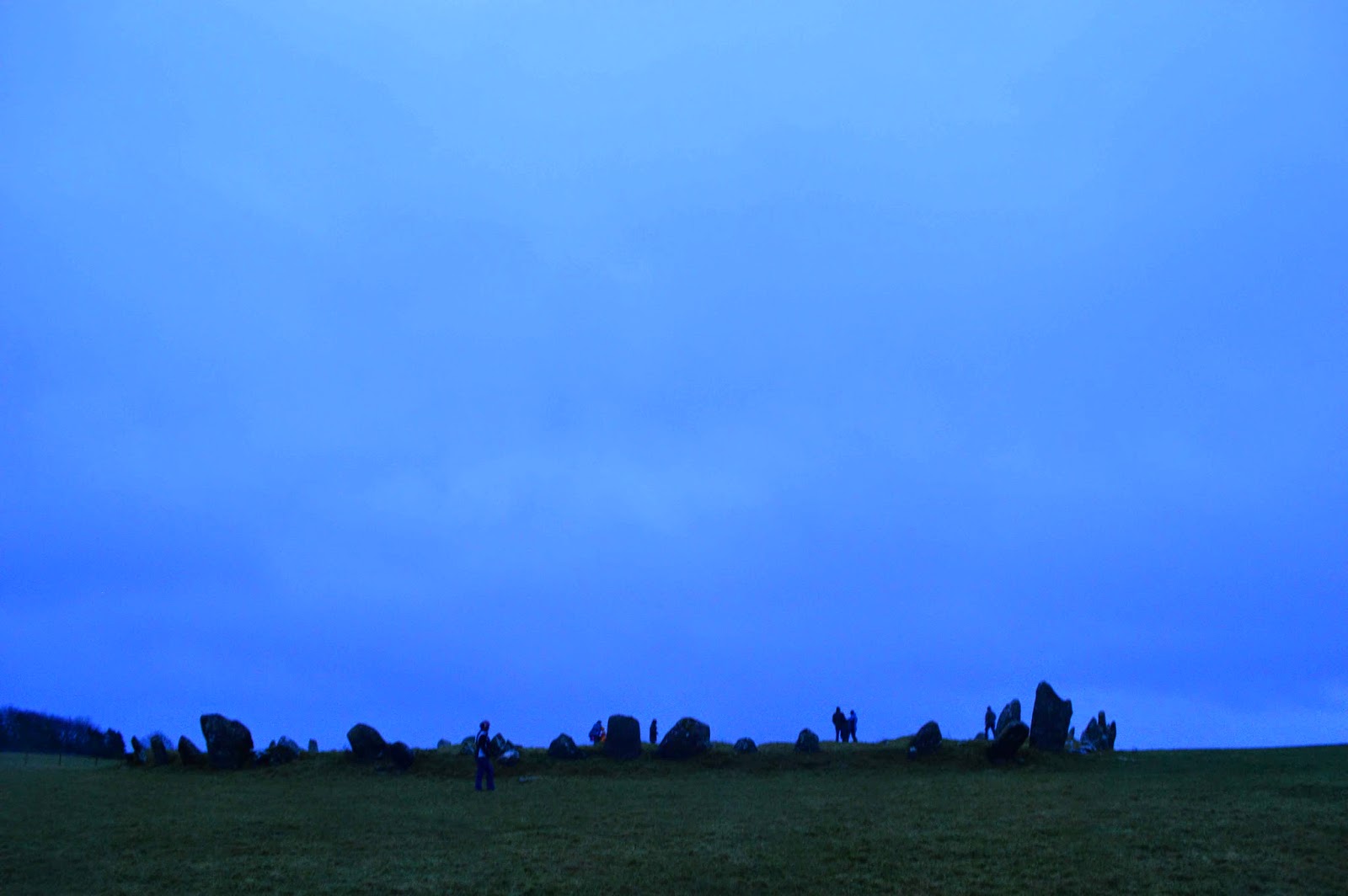
Winter solstice at Beltony with the High Kings


Out today to the stone circle at Beltony, a couple of miles from Raphoe. It is, of course, the winter solstice. We got there just after half eight. We arrived just behind a teller of tales and just ahead of Kathryn Daily and Stephen. Kathryn has put pics up on Facebook.

On the path up, we passed the remains of a circular structure among the trees on the right. As a child I'd always imagined this to be a round tower. I was disappointed to see it marked on a map as a windmill. But then lo and behold! in the Donegal Annual Volume 1 (1947-1953) there's a note about it being a round tower after all. Still looking for that note - I think it said the tower was used as a scriptorium, a place for copying manuscripts. The tower might also have been useful for keeping an eye on the stone circle and who might be going there.

This little hill is where I grew up, in a house beside where you park your car now before taking the short but steep-ish lane to the circle. This townland is called The Tops. It's a good description of it as a place to spend your early years, but again I was a little disappointed that the townland name wasn't an ancient Irish one linked with the circle. Then a while back I opened the Irish Times and found The Tops mentioned in the 'Words We Use' column from Diarmuid Ó Muirthile. It seems the name comes from 'Tap tineadh', the place where the torches were lit before the procession to the circle. Perfect! Coincidentally, I see that Diarmuid's death in Vienna was reported in the Irish Times exactly a year ago today.

There are many fascinating aspects to the circle and indeed the landscape around it. For instance, what monastery is linked with the round tower? An obvious candidate is the monastery at Raphoe - the town name comes from 'Rath Bhoth', the fortification around the (monk's) huts, as we were taught at school. It's thought these huts were made by monks. But I remembered today that not far from the stone circle there is a townland called Ballymonaster, the land of the monastery. I see that in the same area, known locally as Cloughfin, there's also Kilmonaster Lower, Kilmonaster Middle and Churchminister. Jim Lynch, who taught me at Raphoe NS, is a former principal of St Colmcille NS Cloughfin and writes that the Cistercians had a monastery there with Cearnach as abbot.


Christian settlements were often established close to pagan ones, I suppose for the same reasons that Christian festivals were established to supplant pagan ones. The winter solstice rituals gave way to Christmas. This concentration of Christian settlement around Beltony stone circle suggests it was an important place. We all search for significance in our lives. Patrick Kavanagh poked fun at our fond imaginings in his poem 'Epic' -

I have lived in important places, times
When great events were decided : who owned
That half a rood of rock, a no-man's land
Surrounded by our pitchfork-armed claims

However the Tops and Beltony just keep delivering the goods. In his book published in 2006, 'Cenél Conaill and the Donegal Kingdoms AD 500 - 800', Brian Lacey persuasively argues that this part of East Donegal was the homeland of a powerful clan, the Cenél Conaill. This clan began to make a 'national' impact from their "small but economically rich territory in Mag nItha" in the sixth century. According to this analysis, the clan supplied at least five high kings of Tara. Two, and possibly three, of these Cenél Conaill kings of Tara "were the first to be described in the ancient sources with the rare title of 'King of Ireland', however exaggerated that was" (p322).


There was no sun to be seen at sunrise this morning. But when you were looking across in vain towards Croaghan Hill you were surveying the home ground of the Cenél Conaill and your feet were  firmly planted in historic Irish landscape.


*******************

By coincidence last night I found myself at a 'Celtic Banquet' at the Grianan of Aileach Hotel in Burt. Brian Lacey reckons that the great hillfort Grianan of Aileach symbolises the transfer of power away from Cenél Conaill to the Cenél nÉogain after the battle of Clóiteach in 789. Brian suggests that Cenél nÉogain chief Áed may have celebrated his victory over Cenél Conaill by building the Grianan of Aileach - "as a visible reminder of who ruled, the monument could be seen from a great many parts of that kingdom". The Cenél nÉogain, who gave their name to Inishowen, then became big cheeses in Ireland. The Cenél Conaill was practically written out of the annals in what Brian likens to"a sort of Stalinization". History is written by the victors. But as recent resident of Fahan, that historic Inishowen spot, I also claim Cenél nÉogain connections!

********************

Friday, 12 December 2014

Eyewitness account of the fire at Raphoe Castle 1838


Came across a curious little book in the library in Letterkenny, 'Reminiscences of a Long Life', by W. D. Killen, D.D., LL.D., President of Belfast Presbyterian College. It's a little A6 size one (the pages a quarter of an A4 page) and it's number 145 of an edition of just 200 copies produced by Braid Books and Moyola Books in 1995.
The great treat for a Raphoe man in this book is the eyewitness description of the fire which destroyed Raphoe Castle in 1838. William Doole lived through almost all of the 19th century, and he was serving as Presbyterian Minister in Raphoe at the time of the fire. And there's much more of interest in the book, including more about life in Raphoe during his ministry there, a description of Belfast in 1820, when it was still a relatively small place of 30,000 people, and the entertainment of W.D.'s often forthright opinions.
William Doole Killen was born in Ballymena on Easter Saturday, 5th April, 1806, and died on 19th January, 1902, the year after these reminiscences first appeared in print.
As time is short this morning, we'll focus on the fire for the moment.
W. D. had good time for the last Church of Ireland Bishop to live in the castle, the Right Rev. Dr. Bissett, "a most respectable country gentleman". The Bishop was well off, a Scottish man with an estate in Aberdeenshire, and the income from the diocese of Raphoe seems to have been substantial - W.D. says "from his see he had an income of upwards of five thousand a year", maybe around £400k in today's money.
W. D. continues:
About this time Parliament passed an Act for the suppression of the see. I had occasion to call on the Bishop shortly afterwards, and found him walking along in his demesne. He was somewhat dejected. "I have now, Mr. Killen," he said to me mournfully, "no great pleasure in going through these grounds. I care not to plant a tree here, for I know not who is to sit under the shadow of it. It may be a Romish bishop." [ . . ]
He did not long survive the passing of the Act for the suppression of the bishopric. In accordance with it the see was extinguished on his demise, and the castle became vacant. It had been built 200 years before by Bishop Leslie. It was a beautiful and spacious edifice, surrounded by an extensive park, and no cost had been spared on its construction. It was now offered for sale; but as no purchaser willing to give the required price was forthcoming, it remained untenanted. Fires had been kept up in some of the apartments, but no fenders had been provided to surround the fireplaces ; and it was said that a live coal, falling out of the grate in one of the rooms, had ignited the flooring ; and as the caretaker happened to be absent, the fire spread unnoticed until it was found impossible to arrest its progress. I well remember the night of the burning. I was sitting in my house at the other extremity of the village when the deep-toned bell of the cathedral began to ring violently, and immediately afterwards I received intelligence that the castle was on fire. In company with some others, I set out for the scene of the disaster. I found a crowd already assembled there in front of the main building, watching the progress of the devouring element. The fire roared and glared as it burst through the edifice. The inner partitions of the castle were composed of dry peat or turf, overspread with mortar, and had apparently been chosen to diminish the weight of the pressure on the ceilings of the apartments underneath. As these partitions, one after another, tumbled into the mass of fire, the flame was prodigious. The conflagration increased, and the whole country was illuminated."
W. D. adds -
At this time the Established Church of Ireland at Raphoe was overtaken by a whole series of calamities. The cathedral took fire ; the bishop died ; the dean, overwhelmed in debt, fled from the country ; the see was suppressed ; the castle was reduced to a mass of ruins ; and one of the curates, who became insane, for a time created a great sensation by his strange utterances in the pulpit and elsewhere.
At the death of the bishop the little town contained 1,500 inhabitants. The population has since much declined, and is now somewhere between 900 and 1,000.

It seems that Lord George Hill could have been Raphoe Castle's saviour, as I heard Sophia Hillen, author of Mary, Lou and Cass: Jane Austen's nieces in Ireland  say he was thinking of buying it before opting instead for Ballyarr House in Ramelton in 1842.